

Structural Steel vs. LVLs Beams for Grand Rooms in Pima Canyon Estates
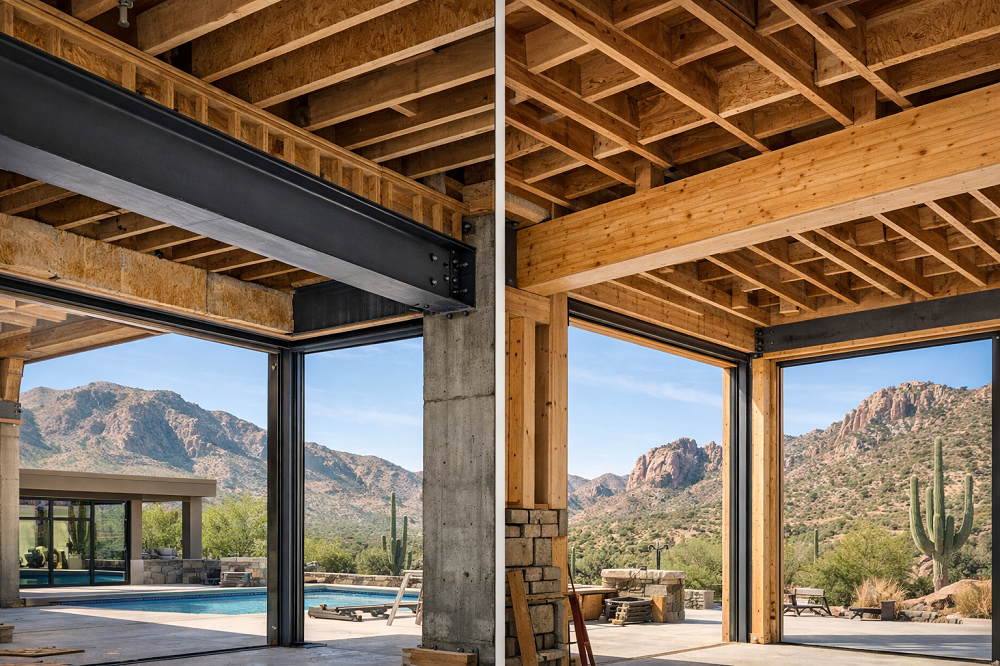
You already know that the architecture here in Pima Canyon Estates demands something special. The sprawling open floor plans, soaring ceilings, and dramatic mountain views that define this Tucson, Arizona community require structural systems that can carry serious loads while disappearing into elegant finishes. Two of the most popular choices among local builders and architects are structural steel beams for homes and LVL beams for home construction. Both are capable, but they serve different needs, carry different costs, and perform differently in the desert Southwest climate. Understanding the distinction can save you time, money, and headaches before the first footing is poured.
What Are Structural Steel Beams and LVL Beams?
Before diving into the comparison, it helps to understand exactly what each material is and how it is made. Structural steel beams are rolled sections of carbon steel, most commonly the familiar wide-flange shape that looks like a capital letter H when viewed from the end. They are manufactured in mills under precise tolerances and arrive on site ready to be cut, welded, or bolted into place. Builders who specify structural steel beams for homes are drawing on a material that has been used in commercial construction for over a century, and the engineering data behind it is extensive.
LVL stands for laminated veneer lumber. It is an engineered wood product made by bonding thin sheets of wood veneer together with waterproof adhesive under heat and pressure. The result is a beam that is denser and more dimensionally stable than ordinary dimensional lumber, with fewer of the knots and grain irregularities that can weaken solid wood. LVL beams for home construction have become a standard tool in residential framing over the past few decades because they are predictable, readily available, and easier for most framing crews to handle without specialized equipment.
Spanning the Grand Rooms of Pima Canyon Estates
The homes in Pima Canyon Estates are known for their generous proportions. Great rooms, covered patios, and open-concept kitchens routinely call for spans of twenty feet or more without an interior column interrupting the space. This is where the structural steel vs LVL beams conversation gets serious.
Steel has a clear advantage in raw spanning capability. A relatively compact wide-flange section can carry enormous loads across long distances, which is why steel is the go-to choice when an architect wants a truly column-free room that stretches forty feet or beyond. At those lengths, an LVL beam would need to be stacked several plies deep and might still deflect more than an engineer would approve. Steel also has a much higher strength-to-weight ratio than engineered wood, meaning you can achieve the same structural result with a shallower profile, which matters when you are trying to keep a ceiling at a specific height.
That said, LVL beams hold their own in the twenty-to-thirty-foot range that covers most residential grand rooms. A properly engineered LVL assembly can handle these spans comfortably, and because the material is lighter, the framing crew can often set it without a crane. For projects where the budget is fixed and the spans are within a reasonable range, LVL frequently wins on practical grounds.
Cost, Availability, and Construction Logistics in Tucson, Arizona
Material costs fluctuate, but as a general rule, LVL beams for home construction are less expensive than structural steel beams for homes when you factor in both material and installation. Steel requires certified welders or bolted connections engineered to specific tolerances, a crane or boom truck for lifting heavy sections, and sometimes additional fireproofing or coating depending on where the beam is located. All of those line items add up quickly.
In the Tucson, Arizona market, steel fabrication shops can produce custom sections, but lead times vary and the specialty labor required is more expensive than standard framing crews. LVL beams, by contrast, are stocked at most regional lumber yards and can be ordered in custom lengths with relatively short turnaround. For a custom home in Pima Canyon Estates where the construction schedule is already tight, that availability advantage is real.
On the other hand, some builders prefer steel precisely because it eliminates moisture-related callbacks. Even though LVL adhesives are rated for exterior exposure, engineered wood can still be affected by prolonged wetting during construction. Tucson receives most of its rainfall during the summer monsoon season, so a framing package left open to afternoon thunderstorms is a legitimate concern. Steel simply does not absorb water, and it will not twist, shrink, or develop squeaks as it dries out.
Aesthetic Integration in Desert Modern Architecture
Pima Canyon Estates attracts buyers who appreciate the desert modern aesthetic: clean lines, warm natural materials, and a seamless connection between interior and exterior spaces. The choice of beam material plays directly into how a space looks and feels once it is finished.
Structural steel beams are increasingly specified as a visible architectural element. Exposed steel with a dark primer or patina finish has become a signature look in upscale Tucson homes, pairing beautifully with concrete floors, clay plaster walls, and rough-sawn wood ceilings. If your designer wants the beam to be a feature rather than something to hide, steel gives you that opportunity in a way that LVL simply cannot match. An exposed LVL beam has a utilitarian appearance that most homeowners prefer to conceal behind drywall or cladding.
When the beam is hidden, however, LVL has no aesthetic disadvantage. Tucked above a flat ceiling or buried in a dropped soffit, an LVL assembly performs its structural role invisibly and nobody in the room will know or care what material is holding up the roof above them.
Structural Engineering Considerations for Desert Climates
Engineers working on custom homes in Pima Canyon Estates must account for seismic activity, high thermal variation, and the occasional high-wind event associated with monsoon storms. The structural steel vs LVL beams decision has implications for all three.
Steel is ductile under seismic loading, meaning it can flex and absorb energy without fracturing. That is one reason steel moment frames are a preferred seismic-resistant system in high-risk zones. For most residential applications in the Tucson area, which sits in a moderate seismic zone, either material can be detailed to meet code, but steel offers more inherent ductility if the engineer wants a margin of safety.
Thermal expansion is another factor. Steel expands and contracts significantly with temperature changes, and in a climate where summer attic temperatures can exceed 150 degrees Fahrenheit, long steel members need properly designed connections that allow for movement. LVL is more dimensionally stable across temperature swings, which simplifies connection detailing in some applications.
Both materials are compatible with the concrete block and poured concrete construction common in Southern Arizona, and both can be engineered to integrate cleanly with post-and-beam systems, steel moment frames, or conventional wood framing.
Conclusion
Choosing between structural steel beams for homes and LVL beams for home construction is not a matter of one being universally superior. It is a matter of matching the right material to the specific demands of your project. In Pima Canyon Estates, where grand rooms, dramatic spans, and architectural ambition are the norm, steel earns its place when spans are long, aesthetics call for exposed structure, or the engineer needs maximum load capacity in a minimal profile. LVL earns its place when the spans are moderate, the schedule is tight, the budget is firm, and the beam will be concealed within the finished ceiling.
The best approach is to bring your structural engineer and architect into the conversation early, share your design goals, and let the technical requirements guide the material selection. A good team working on a custom home in Tucson, Arizona will know how to weigh these factors and deliver a result that is both beautiful and built to last in the desert Southwest.
Need a Renovation Contractor Near You?
Are you ready to bring your remodeling dreams to life? Here at Ralcon LLC, we pride ourselves on delivering exceptional bathroom, kitchen, and whole-home remodels for homeowners right here in Tucson, Arizona. Our commitment to quality, timeliness, and fair pricing has earned us a trusted reputation you can see in our glowing reviews and project gallery. Let us help transform your space with care and precision. Contact us today—we’re ready to make your dream home a reality!